The construction sector across Saudi Arabia, the UAE, and Qatar has been rebuilt twice in five years, once by a pandemic that froze contract awards, and again by a wave of giga-project spending that reshaped who gets hired and how projects get built. For anyone bidding, buying, or supplying into this market today, the industry looks structurally different from the one operating in early 2020.
The Contract Award Rollercoaster
GCC contract awards fell to roughly 71 billion US dollars in 2020 as COVID-19 froze project activity. The rebound was sharp: awards climbed to close to 116 billion dollars in 2021, driven by higher oil prices and delayed projects restarting. That recovery didn’t hold in a straight line. 2022 saw awards drop to around 94 billion dollars, with the UAE’s new contracts falling roughly 25 percent and Qatar’s dropping 44 percent as it cut spending ahead of the FIFA World Cup. Saudi Arabia was the exception through this entire period. The Kingdom awarded 54.2 billion dollars in contracts in 2022, keeping its project market larger than the other five GCC states combined.
By 2023, construction contributed close to 141 billion dollars to GCC GDP, with Saudi Arabia’s share rising to 56 billion dollars from 51 billion the year before. In 2024, Saudi Arabia alone issued contracts worth 146.8 billion dollars, including 28.4 billion in construction specifically, while the overall GCC construction market reached 147.1 billion dollars. The pace has since cooled slightly: the GCC awarded 67 billion dollars in contracts across just the first five months of 2025, down from 110 billion dollars over the same window in 2024, a sign that the post-pandemic spending surge is settling into a steadier, still substantial baseline.
What’s Actually Driving the Spend
Two national strategies explain most of the current pipeline. Saudi Arabia’s Vision 2030 has allocated more than 1.1 trillion dollars to real estate and infrastructure, including 500 billion for NEOM and 100 billion for the Red Sea Project. On the UAE side, the Operation 300bn strategy aims to raise industrial sector contribution to GDP from AED 133 billion to AED 300 billion by 2031, directly fueling demand for industrial construction, including the warehouse, storage, and labor accommodation structures that come with it.
Behind both strategies sits demographic pressure. The GCC’s urban population is expected to grow 30 percent between 2020 and 2030, with close to 84 percent of residents living in urban areas by the end of the decade, and the region’s overall population is projected to reach 66 million by 2030, up from 54 million in 2020, according to World Bank figures.
Labor Rules Changed the Cost Structure
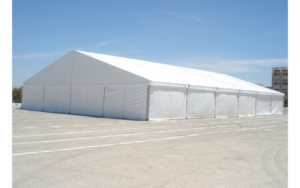
The single biggest operational shift for contractors has been labor regulation. GCC states have rolled out Wage Protection Systems requiring electronic salary transfers, which combined with equalized social security charges has pushed total labor costs up an estimated 15 to 20 percent for expatriate-heavy workforces. In the UAE specifically, the Ministry of Human Resources and Emiratisation enforces a mandatory midday work break during peak summer months alongside stricter labor accommodation standards, rules that have made properly engineered, ventilated shelter for site workers a compliance requirement rather than a nice-to-have. That regulatory shift is a direct driver behind rising demand for the kind of engineered labor tents and rest shelters covered in our companion piece on vetting tent manufacturers before signing a contract.
Material costs moved just as sharply. UAE construction material prices rose 23 percent in 2022, with steel prices up 41 percent compared to 2021, a jump that pushed contractors toward more disciplined procurement and, in many cases, longer-term supplier relationships over one-off lowest-bid sourcing.
Consolidation and the Rise of Regional Contractors
Market concentration has increased. The top 10 contractors captured about 60 percent of total contract value across the GCC in 2024, with global players like Bechtel securing 8.5 billion dollars in awards and China State Construction Engineering Corp booking 12.2 billion. Regional firms have held their ground inside that concentration rather than being squeezed out. ALEC Engineering and Contracting, headquartered in Dubai, has become one of the region’s recognized names in this period, forming a robotics alliance to automate high-rise floor construction as labor cost pressure pushed contractors toward automation. Al Naboodah Construction Group, another Dubai-founded major player with decades of UAE infrastructure and building work behind it, has similarly expanded its footprint across the transport and utilities projects that now make up a growing share of regional contract value.
Where This Leaves Buyers and Suppliers
The GCC construction market of 2026 rewards contractors and suppliers who can absorb higher labor and material costs through better engineering and automation rather than passing every increase straight to the client, and who can meet labor accommodation and safety compliance without being told twice. Localization rules requiring 30 to 40 percent local employment in Saudi Arabia and the UAE add another layer: international firms are increasingly forming joint ventures with regional players to meet these requirements while keeping projects moving. For anyone sourcing structures, materials, or labor solutions into this market, the lesson from the last five years is straightforward. The buyers who priced purely on the lowest quote through 2020 and 2021 are the same ones who paid for it in downtime and rework once material and labor costs corrected in 2022 and beyond.